
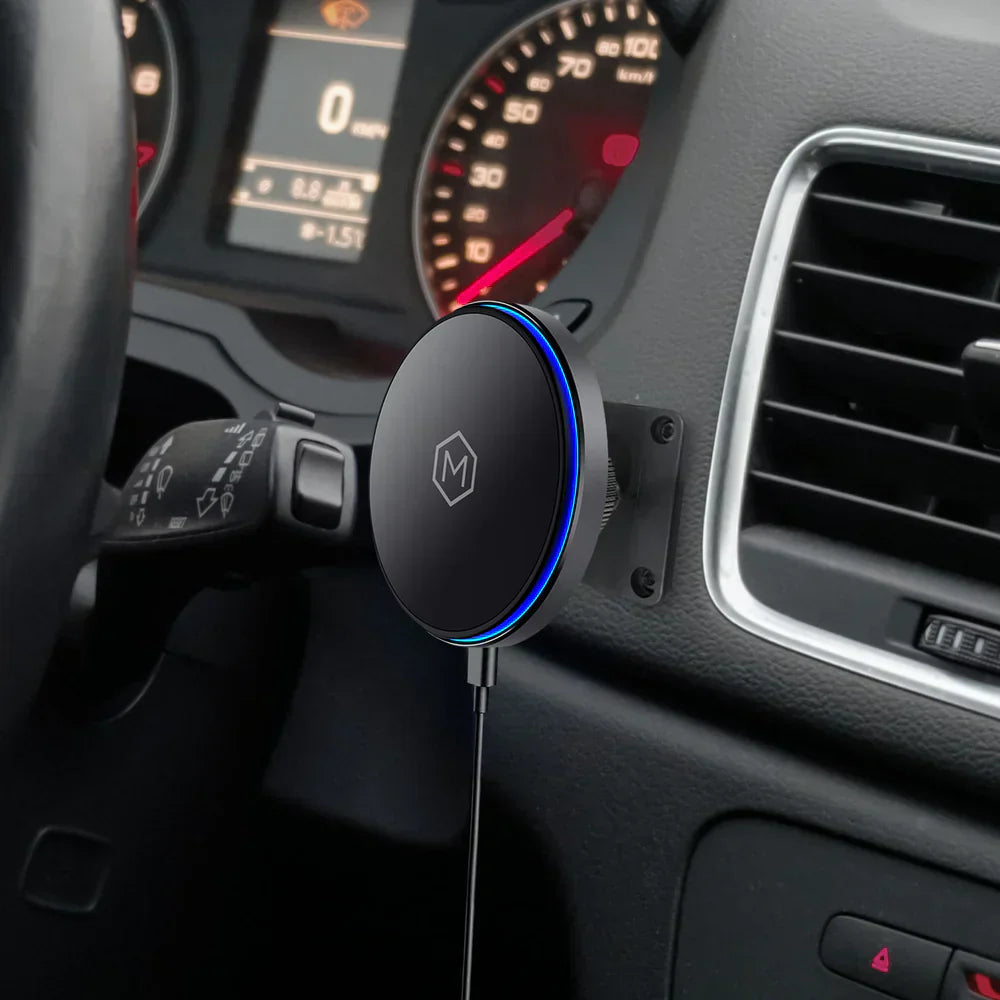
For a casual driver, a suction cup mount that needs to be re-attached every few weeks is a minor annoyance. For a long-haul truck driver covering 600 kilometres a day, or a fleet operator running 30 vehicles across multiple shifts, a mount that moves is a mount that fails. Professional drivers don't need a phone holder — they need infrastructure. That is exactly what a drill-base wireless charging mount delivers.
The Commercial Driver's Reality
A truck cab or fleet vehicle is a fundamentally different environment to a passenger car. The vibration profile is more intense and sustained — hours of highway driving at constant speed creates a continuous low-frequency vibration that fatigues every component in the cab, including whatever is holding your phone. Temperatures swing from below freezing on winter overnights to 60°C inside a cab left in summer sun. And in a fleet context, the vehicle may be used by two or three different drivers across a 24-hour period, each with different phones and different preferences for where the screen sits.
Standard consumer mounts were not designed for this. They were designed for a commuter who drives 40 minutes each way and parks in a temperature-controlled garage. The engineering assumptions behind a suction cup rated for 500 uses simply don't hold up across a commercial vehicle's operating calendar.
The professional standard: In commercial and fleet use, a phone mount is not an accessory. It is part of the vehicle's operational equipment — expected to function reliably across thousands of hours, multiple operators, and extreme environmental conditions.
Why Consumer Mounts Fail in Trucks and Fleet Vehicles
Vibration Fatigue
Sustained highway vibration gradually loosens suction seals, fatigues adhesive bonds, and works locking mechanisms loose. What holds fine for a commuter fails within weeks of commercial use.
Temperature Extremes
Suction cups lose grip in heat. Adhesive cures differently in cold. A mount that works in a temperature-controlled car may fail entirely in a cab that reaches 60°C on a summer afternoon.
Multiple Operators
Every time a new driver adjusts or removes the mount, a suction cup or adhesive base is stressed. Consumer mounts aren't designed for the daily handling a shared fleet vehicle involves.
Surface Incompatibility
Truck dashboards are often textured, curved, or covered in materials that suction cups and adhesives don't bond to reliably. The same surface issue applies to many commercial vans and work vehicles.
These are not minor inconveniences in a commercial context. A driver whose phone falls at highway speed faces a dangerous distraction and a potentially serious accident risk. A fleet manager whose vehicles need mounts re-seated every few weeks faces a maintenance cost and a productivity problem. The consumer mount category simply was not built to solve these problems.
What the AMPS Drill-Base Standard Solves
AMPS stands for Adapter Mounting Plate Standard — a four-hole bolt pattern originally developed for military and public safety vehicle equipment that has since become the industry standard for permanent in-vehicle device mounting. A mount using an AMPS base bolts directly to the vehicle surface through four points, using hardware that is tightened to spec and stays there.
The difference in practice is absolute. A drilled-in AMPS mount does not move. Not on a rough gravel road. Not on a washboard highway surface at 100km/h. Not after a year of daily commercial use across multiple drivers and seasons. The mount is part of the vehicle in the same way the radio or the seat adjustment lever is part of the vehicle — it is there, it works, and it does not require thought or maintenance to keep it that way.
"A drilled mount is not an accessory. It is vehicle infrastructure — and it behaves like it."
For fleet operators, the AMPS standard also enables consistent cross-vehicle installations. Every vehicle in a fleet can be configured identically — same mount position, same viewing angle, same setup for every driver. That consistency reduces driver adjustment time, eliminates the variability of each operator re-mounting a phone, and creates a predictable standard across the entire fleet.
Why Wireless Charging Is the Next Logical Upgrade
Once a driver has moved to a drill-base mount, the next friction point becomes the cable. In a commercial cab, charging cables create a specific set of problems that don't affect casual drivers nearly as much.
Cables in a working cab get caught, pulled, and damaged constantly. A driver picking up a phone quickly to check a delivery address pulls on the cable connector. A second driver adjusting the mount position strains the cable at the port. Over weeks of daily commercial use, micro-damage accumulates at the cable connection point — one of the most fragile points on any smartphone. Port damage in a commercial context means a phone that can't charge reliably mid-shift, which means a driver without navigation when they need it most.
Beyond damage risk, cables add clutter to a working environment that already has limited space. Truck cabs are workspaces. Every cable is something that snags, something that has to be managed, something that can pull a phone out of a mount at exactly the wrong moment.
Qi2 wireless charging at 15W removes all of this. The phone snaps onto the magnetic charger, charges at full speed, and can be removed and replaced in a single motion with no cable management required. Between the permanent stability of the AMPS base and the cable-free convenience of Qi2, the entire phone mount and charging problem in a commercial cab is solved in one product.
The Fleet-Specific Case for Qi2 Over MagSafe
In a fleet context, the distinction between MagSafe and Qi2 matters more than it does for individual consumers. MagSafe delivers 15W fast charging, but only on Apple devices. A fleet of 20 vehicles whose drivers use a mix of iPhones and Android devices — which is typical in most commercial operations — cannot standardise on a MagSafe charging mount without excluding a portion of its drivers.
Qi2 is the open standard. It delivers 15W fast charging on MagSafe-compatible iPhones natively. It works on Qi2-enabled Android devices natively. And for any device that does not natively support Qi2 magnetic charging, the magnetic ring accessory included with Mighty Mount's MagSwitch Qi2 mounts solves the compatibility gap in seconds. One mount standard, any phone, any driver, any shift.
For fleet managers: Standardising on Qi2 means one SKU covers your entire driver base regardless of what device each person carries. No per-driver hardware decisions, no compatibility exceptions, no cables to replace.
The Five Reasons Fleet and Truck Drivers Are Making the Switch
-
01Zero movement across the entire working day A drill-base mount bolted into the vehicle does not shift, rattle, or require re-seating between shifts. The phone is in the same position at the end of a 10-hour run as it was at the start. For drivers who rely on navigation throughout a working day, that consistency directly reduces distraction and error.
-
02No cable management in a working cab Wireless Qi2 charging eliminates the cable entirely. The phone snaps on and charges. No connector wear, no cable clutter, no port damage from repeated plugging under time pressure. In a working cab, the absence of a cable is a meaningful quality-of-life and equipment longevity improvement.
-
03Works on any dashboard surface AMPS drill mounting works on any surface that can take a bolt — textured plastics, metal consoles, custom cab fitouts. None of the surface compatibility issues that make suction cups and adhesives unreliable in commercial vehicles apply to a bolted installation.
-
04Handles multiple operators without adjustment Because the base never moves and the phone simply snaps on magnetically, a shift handover is frictionless. The incoming driver attaches their phone in one motion and drives. No repositioning the mount, no re-seating a suction cup, no finding where the previous driver left the cable.
-
05Built to last across commercial operating hours A consumer suction mount may be rated for 500 uses. An AMPS drill-base installation, done correctly, is rated for the life of the vehicle. For a fleet operator standardising across 20 or 30 vehicles, the total cost of ownership difference between consumer mounts replaced annually and permanent drill-base installations is significant.
Mighty Mount AMPS Drill-Base Mounts
Mighty Mount offers AMPS drill-base mounting across both the MagSwitch Qi2 wireless charging range and the Samsung Galaxy Z Fold spring-loaded grip range. Both use the standard four-hole AMPS bolt pattern, require no special tools beyond what comes in the box, and are backed by a 100% satisfaction guarantee.
Wireless Charging
AMPS Plate Qi2 Magnetic Charger Phone Mount
Permanent AMPS bolt-in installation with 15W Qi2 wireless charging built in. Phone snaps on magnetically, charges at full speed, and removes in one motion between shifts. Compatible with MagSafe iPhones, Qi2 Androids, and any device using the included magnetic ring. The complete solution for fleet and commercial cab use.
View product →Grip Mount
AMPS Drill Base Galaxy Z Fold Car Mount
The same permanent AMPS drill-base installation paired with Mighty Mount's spring-loaded, adjustable grip holder for the Samsung Galaxy Z Fold. Hinge-safe clamping, 360° rotation for portrait and landscape, and the zero-movement security of a bolted installation — for Z Fold users who prefer a physical cradle over magnetic charging.
View collection →Looking at the Full Mighty Mount Range?
Beyond the AMPS drill-base options, Mighty Mount's MagSwitch Qi2 range offers four additional mounting configurations — vent, suction, telescopic, and gooseneck — for drivers who want wireless Qi2 charging without a permanent installation. The Galaxy Z Fold collection covers ten base configurations with the spring-loaded foldable phone grip.
For drivers whose vehicle is their workplace and whose phone is a working tool, consumer-grade mounts are the wrong starting point. The right infrastructure — permanent, cable-free, and compatible with every phone on the team — is a one-time decision that pays back in reliability across every kilometre driven after it.